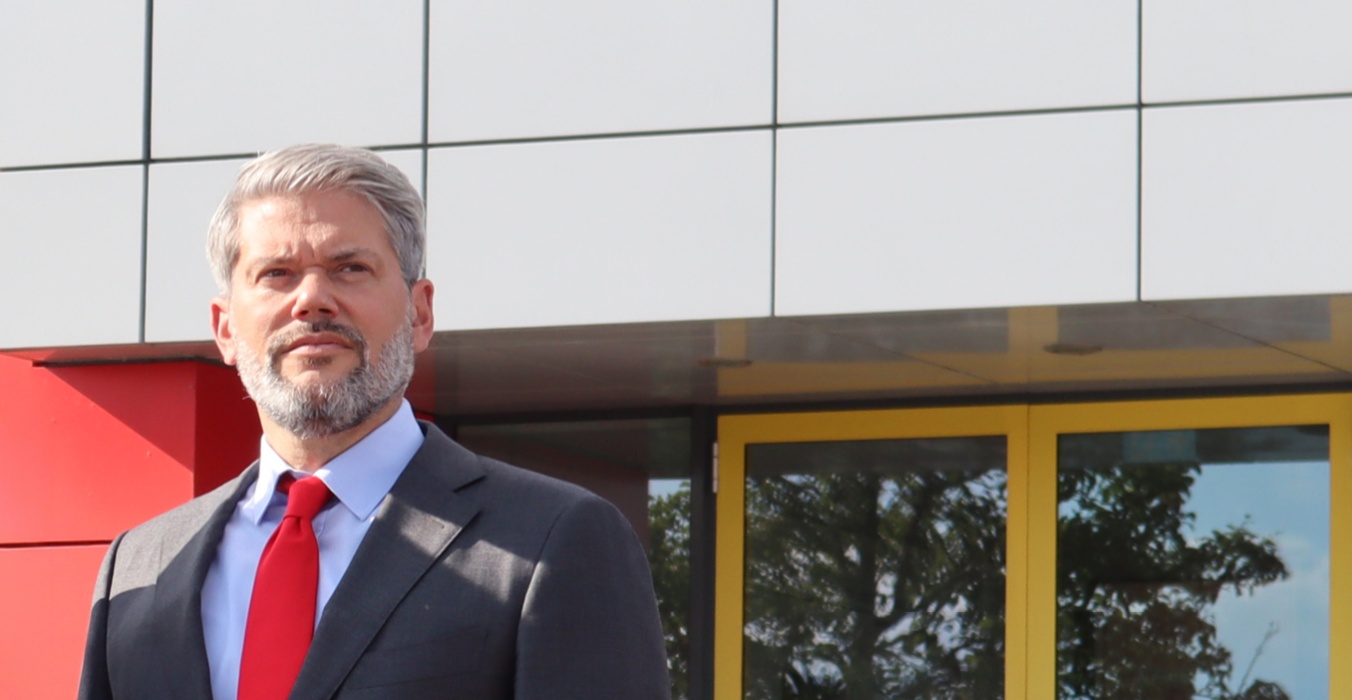
Building the next 35 years
Interview with Jelmer Domela, Managing Director at Alphatron Marine Netherlands.
On Knowledge, Connectivity, and the Future of the Maritime Industry
The first 35 years of Alphatron Marine were defined by entrepreneurship, technological innovation, and international growth. The next 35 years will look very different. Technology is advancing faster than ever before. Geopolitical developments are reshaping global trade patterns. At the same time, the availability of technical talent is becoming increasingly limited.
Yet according to Managing Director Jelmer Domela, the greatest challenge is not technology itself.
"Technology can be developed, acquired, or integrated. The real challenge lies in people and knowledge."
For that reason, his vision of the future is not centered solely on new products or systems. Instead, it focuses on preserving, sharing, and leveraging knowledge in an increasingly complex and rapidly changing world.
An industry in motion
The maritime industry has always been forced to adapt. However, Jelmer believes the pace of change has accelerated dramatically in recent years. "We are dealing not only with technological developments, but also with geopolitical shifts, changing trade routes, new regulations, and rising customer expectations."
According to him, global shipping is deeply connected to the broader world economy. "What happens on the other side of the world often has a direct impact on our customers and ultimately on us as well."
That reality demands flexibility. "You have to constantly identify opportunities and determine how to respond to them." In his view, that is nothing new for Alphatron Marine. "Entrepreneurship ultimately means continuing to move forward."
Growth requires a broader perspective
When Jelmer looks toward the future, he sees significant opportunities for continued growth. That growth, however, will not come from products alone. "Customers increasingly expect complete solutions."
Where individual systems were once delivered separately, demand is shifting toward integration, connectivity, and service-based solutions. "It's no longer about a single radar, a single communications system, or a single application. It's about how everything works together."
This applies not only to deep-sea shipping, but also to inland shipping and emerging developments in remote operations. "Complexity is increasing, yet customers expect greater simplicity at the same time." According to Jelmer, this creates a major opportunity for Alphatron Marine. "Our role is increasingly evolving into that of a systems integrator and trusted knowledge partner."
The greatest challenge: people
When the conversation turns to the future of the organization, Jelmer quickly arrives at the topic of people.
"The availability of technical talent will be one of the biggest challenges in the years ahead." According to him, this challenge extends beyond Alphatron Marine and affects the entire technical sector. "We see experienced professionals retiring, while at the same time it becomes increasingly difficult to attract new technicians."
That is why he believes organizations must look beyond traditional solutions. "We need to make smarter use of the knowledge we already have." Where expertise was once largely concentrated within individual employees, he believes that knowledge must increasingly become part of the organization itself. "You want to prevent knowledge from disappearing when someone leaves or retires."
From experience to collective knowledge
For that reason, Alphatron Marine is investing heavily in capturing and structuring knowledge. "Every organization contains an enormous amount of valuable information. The challenge is making that information accessible."
According to Jelmer, this goes beyond documents and manuals. "It's about practical experience. It's about solutions people have developed in the past. It's about lessons learned during projects." That knowledge should be available throughout the organization.
"If someone in Singapore learns something, we want that knowledge to be available to colleagues in the Netherlands, Belgium, or anywhere else." He sees this international exchange of knowledge as a key success factor for the future.
AI as an accelerator
Artificial intelligence plays an increasingly important role in that process. However, Jelmer approaches AI pragmatically. "AI is not a goal in itself." According to him, everything starts with quality data. "AI only creates value when the underlying knowledge is properly captured and structured."
That is why Alphatron Marine continues to invest in systems that structure information and make it accessible. "Once knowledge is available, intelligent systems can help us find and apply that knowledge more quickly." This creates opportunities in many different areas.
"Whether it's engineering, service, project management, or quotations, many processes can be organized more intelligently and more efficiently." Jelmer emphasizes that the objective is not to replace people. "The goal is to make people stronger."
More room for expertise
One of the major benefits of digitalization, in his view, is that employees can spend more time on work that genuinely adds value. "Today, we sometimes solve problems that have already been solved somewhere else." By making knowledge more accessible, organizations create more room for innovation, creativity, and complex problem-solving.
"We want to spend less time on repetitive work and more time on the activities where human expertise truly makes a difference." This applies to experienced employees as well as newcomers. "Technology can help young professionals learn faster and become productive more quickly."
Connectivity as a basic utility
Another development that Jelmer believes will shape the coming years is the continued growth of connectivity. "Connected systems are rapidly becoming the norm."
New satellite technologies are providing vessels with access to fast and reliable communications virtually anywhere in the world. "Connectivity will become as commonplace as electricity or internet access in an office."
That creates new opportunities for remote support, monitoring, and data-driven services. "When systems are continuously connected, we can help customers more quickly and identify problems earlier." According to Jelmer, we are only at the beginning of this development.
Cybersecurity becomes part of everything
Greater connectivity also brings new responsibilities. "Cybersecurity is becoming increasingly important."
Where digital security was once viewed as a separate topic, Jelmer expects it to become fully integrated into every system and process. "It will no longer be a separate discipline. It will become a natural part of everything we do." In his view, this applies not only to suppliers but to the entire maritime industry. "Customers rightly expect their systems to be secure, reliable, and future-proof."
Moving toward greater autonomy
Jelmer also expects significant developments in automation. "We will see increasingly intelligent systems."
At the same time, he does not believe ships will operate entirely without people in the near future. "People will remain important." However, he does expect the role of crews to evolve.
"More and more routine tasks will be supported or taken over by technology." As a result, focus will shift from execution to supervision, analysis, and decision-making. "For certain applications, we are already seeing developments toward remote operations and partial autonomy."
According to him, the question is no longer whether this evolution will continue, but how quickly it will progress.
The power of long-term thinking
Beyond technological developments, Jelmer also sees tremendous value in Alphatron Marine’s position within the JRC Group. "One of the major advantages is long-term thinking." According to him, this creates room to invest in people, innovation, and knowledge development. "You can build for the future when you're looking beyond today's results."
Over the past several years, he has also seen mutual understanding between the two organizations continue to grow. "We have gained increasing respect for each other's strengths." In his view, that forms a solid foundation for further development.
The next generation
Looking ahead to the next decade, Jelmer sees an organization that continues to evolve while remaining true to its roots. "Technology will change. Our products will change. Customer expectations will change."
What will not change, he believes, is the DNA on which the company was built. "Curiosity, entrepreneurship, technical expertise, and commitment to customers."
According to him, these values form the bridge between the past and the future. "Much of what has made Alphatron Marine successful will remain relevant in the future."
For that reason, he has a clear message for the next generation of professionals: "Keep learning. Stay curious. And don't be afraid to explore new ideas." In his view, progress often begins with people who are willing to challenge existing ways of working.
The next 35 years
If there is one common thread Jelmer sees throughout Alphatron Marine's history, it is the ability to adapt to change without losing its identity. "That may well be our greatest strength."
The years ahead will bring new challenges. New technologies. New markets. New expectations. Yet he believes the essence will remain the same. "The future is not only about technology."
Ultimately, it is about people using technology to solve problems, helping customers move forward, and creating new opportunities. "As long as we continue doing that, I have every confidence that the next 35 years will be at least as interesting as the past 35."



Related articles
View all articles
35 years of Alphatron Marine
The past, present, and future of Alphatron Marine through the eyes of Luuk Vroombout, Founder and Former President, Alphatron Marine Group, Jun Nakazawa, Chief Executive Officer, JRC | Alphatron Marine, and Jelmer Domela, Managing Director, Alphatron Marine Netherlands.

Between tradition and the future
Interview with Jun Nakazawa, Chief Executive Officer at JRC | Alphatron Marine.

From underdog to global player
Interview with Luuk Vroombout, founder and former president of the Alphatron Marine Group.
