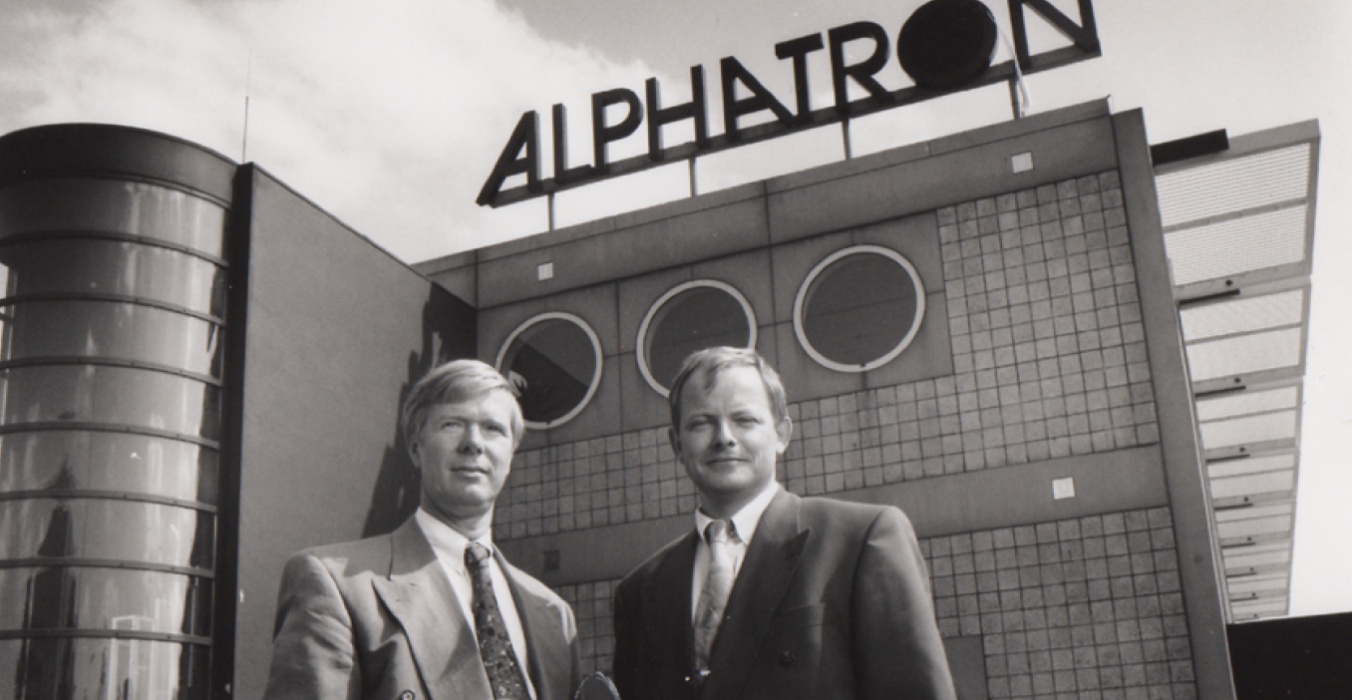
From underdog to global player
Interview with Luuk Vroombout, founder and former president of the Alphatron Marine Group.
35 years of Alphatron Marine through the eyes of its founder
Anyone looking at Alphatron Marine today sees an international organization with offices, partners, and projects around the world. Looking back to the beginning, however, reveals a very different picture: a small company fighting to establish itself in a market dominated by well-established players.
For founder Luuk, that period still feels remarkably close. Not because he longs for the past, but because many of the lessons learned during those early years remain just as relevant today. "We may no longer be the underdog we once were, but we should never lose that mentality."
Learning through experience
Before there was entrepreneurship, growth plans, or international ambition, Luuk worked as a service engineer. Carrying a bag full of tools, he traveled the world installing systems, troubleshooting equipment, and supporting customers. "That was my education. Not from a textbook, but in the field."
It was precisely that hands-on experience that shaped him. According to Luuk, working as a service engineer teaches far more than just technical skills. "You learn to think independently. When there’s a problem somewhere, nobody is standing next to you telling you what to do. You have to find solutions yourself."
Sometimes that happened under extraordinary circumstances. From equipment failures in remote ports to improvising with limited resources to get a vessel operational again, he once fashioned temporary belts out of nylon stockings in Nigeria so that a radar could keep running and the customer could continue operating, at least for a while.
"Above all, you learn one thing: don't think in terms of problems, think in terms of solutions." That mindset would later become an important part of Alphatron Marine’s culture.
Customers kept calling
In the years that followed, Luuk moved into a commercial role because the company he worked for lacked sufficient technical expertise within its sales department. To his surprise, many customers were not so much interested in the organization he worked for, but in the relationship they had built with him.
"I wasn't even supposed to handle the major deep-sea shipping accounts, I was assigned the simpler business. But those customers just kept calling me anyway."
According to Luuk, there was a simple reason for that. "They knew me as the person who came on board when something needed to be fixed. Not as a salesperson, but as someone who understood their challenges."
At the same time, he saw the company he worked for was changing. An acquisition introduced new structures, procedures, and management layers. Relationships, once central to the business, gradually gave way to growing distance between the organization and its customers.
"That didn't feel right to me. Ultimately, it's always about people."
Taking the leap into entrepreneurship
The idea of starting his own business developed gradually. Not through some grand master plan, but through a conviction that things could be done differently. "I saw opportunities and customers saw them too. They wanted to work with people who understood their business." Even so, the decision remained daunting. "You're leaving certainty behind. You don't know exactly what's going to happen. But sometimes you simply have to make a choice."
Eventually, he enrolled in evening classes to study Business Economics. There, he found himself sitting next to what he describes as "a little red-haired guy, just like me." That turned out to be Dick Slingerland, founder of Alphatron. After several months of good conversations, Dick invited Luuk to visit his company.
"I walked into Alphatron and immediately received a warm welcome. People were enthusiastic. It was something I had missed for a very long time." Yet the decision was not easy. Due to a non-compete agreement, he would not be allowed to work in the shipping industry for two years, and ships had always been his passion.
In September 1989, he ultimately decided to move forward with the partnership, encouraged by his wife Leny who had a good feeling about Dick. Looking back, he considers it one of the most important decisions of his life.
Since his former employer did not sell handheld radios or camera systems, Luuk cleverly seized the opportunity to build that business segment, allowing him to remain active in the maritime world he loved so much. This marked the beginning of Alphatron Marine.
The underdog among industry giants
The maritime market of the late 1980s and early 1990s was dominated by large, established organizations. "We truly were the underdog." That meant Alphatron Marine had to fight for every project from day one.
"You can do one of two things: you can complain that others are bigger, or you can show customers why they should choose you."
Luuk chose the latter. Despite competitors attempting to push Alphatron Marine out of the market, customers kept coming. "We never aspired to be the biggest. We aspired to be the best."
That meant staying close to customers, responding quickly, and taking responsibility when things went wrong. "If a customer had a problem, we went there. It was that simple."
According to Luuk, that was where the difference was made. "Many companies assumed customers would stay automatically. We believed trust had to be earned again every single day."
Quality is not open for discussion
One principle Luuk never compromised on was quality. "If something wasn't right, it had to come out, even if it meant we had to absorb the cost ourselves." That applied to products, installations, and projects, but also to details others might never notice.
"I would walk through the workshop and sometimes see a component that worked perfectly from a technical standpoint but didn't look right. I'd say, take it out and do it again."
Not because it was required, but because quality, in his view, is a mindset. "The customer should feel that you're proud of what you deliver. There were times when we deliberately chose the more expensive solution because it was the right choice in the long run."
According to Luuk, that approach always pays off. "A customer may forget which equipment you installed on board, but they'll never forget how you helped them when something went wrong."
The Human Touch in Technology
Over the years, one idea evolved into one of Alphatron Marine's most recognizable core values: The Human Touch in Technology.
For Luuk, it was never a marketing slogan. "It was a conviction."
According to him, technology is often seen as an end in itself, while customers are really looking for solutions. "A captain doesn't buy a radar because he wants a radar. He wants to navigate safely. A shipowner doesn't buy a system because it's technically interesting. They want to improve their operation." That is why he always sought to connect technology with humanity.
"Technicians naturally focus on technology. That's understandable. But ultimately, you're always working for people."
He sees that philosophy reflected in the small gestures. “If people are standing outside on the dock waiting for their vessel in the rain, bring them inside. Offer them a cup of coffee. Hospitality costs nothing, but it can mean everything.”
Respect for technicians
Despite his role as an entrepreneur, Luuk has always considered himself one of the technicians. "Those are still my people. What I’m most proud of is that a technician, supported by other technicians, can build the most successful company in the industry. You don’t need an academic background to do that."
He speaks with great respect about service engineers, engineers, and installers. In Luuk’s view, the value of technical professionals is still often underestimated. "They travel all over the world solving problems that nobody else has an answer to. Much of Alphatron Marine’s success has been built on their dedication."
He still recognizes the same qualities today that helped him throughout his own career. "Curiosity, perseverance, and the determination to find solutions."
Never depend on a single path
Another important lesson from the early years was that independence is essential.
"You should never become completely dependent on a single supplier, a single product, or a single market. We always wanted to think ahead. What happens if the market changes? What happens if technology changes?"
According to Luuk, an organization must continuously look toward the next step.
"You should never think you've made it." In his opinion, that is one of the greatest dangers facing successful companies. "The moment you start believing success is guaranteed, you begin falling behind."
Growing without losing character
There was strong demand for Alphatron Marine’s innovative products, but obtaining components for the company’s own AlphaLine products was not always easy. As a result, Luuk and Dick took a leap of faith and traveled to Japan without a formal appointment. Japan was home to JRC, one of the largest manufacturers of maritime electronics in the world. It was there, in Japan, that the seeds were planted for the eventual acquisition of Alphatron Marine by JRC, a development that would elevate the technological innovations of both companies to a new level.
Over the past 35 years, Alphatron Marine has grown from a relatively small player into a successful international organization. Yet according to Luuk, growth was never the objective in itself. "Growth is wonderful, but only if you preserve your character. Entrepreneurship, commitment, and customer focus have always remained at the core of who we are."
"The world changes. Technology changes. Customers change. But the underlying values must remain recognizable. In the end, that’s what gives a company its identity; trust remains the foundation."
Knowing when to let go
One event that profoundly influenced Luuk’s perspective on entrepreneurship and leadership was the passing of co-founder Dick. "It certainly made me think."
Like many entrepreneurs, Luuk spent years focused on the next challenge, the next opportunity, and the next step forward. "You often think there will always be more time."
The loss of his business partner showed him that such certainty does not exist. "It reinforced for me that you need to think about the future of the company in time, but also about your own future."
That realization led him to consciously step back. "I didn’t want to keep going until I was seventy-five, as you sometimes see. There’s more to life than work alone."
That does not mean he has become inactive. Quite the opposite. Volunteer work, social initiatives, and new projects now occupy a significant part of his time.
"I truly enjoy this stage of my life. The difference is that now I decide where I invest my energy."
Proud of the people
When Luuk looks back on 35 years of Alphatron Marine, he sees an organization that has grown far beyond anything he could have imagined. Yet he always returns to the same conclusion.
"Stay curious. Stay close to your customers. And keep proving your value every single day. That’s what brought us to where we are today."
When asked what he is most proud of, Luuk does not mention revenue figures, acquisitions, or major projects. His answer comes without hesitation: "The people. The colleagues who built the company. The customers who placed their trust in us. The partners who contributed to our success over so many years. Many of those relationships have lasted for decades. That may be the most beautiful achievement of all."




Related articles
View all articles
35 years of Alphatron Marine
The past, present, and future of Alphatron Marine through the eyes of Luuk Vroombout, Founder and Former President, Alphatron Marine Group, Jun Nakazawa, Chief Executive Officer, JRC | Alphatron Marine, and Jelmer Domela, Managing Director, Alphatron Marine Netherlands.

Building the next 35 years
Interview with Jelmer Domela, Managing Director at Alphatron Marine Netherlands.

Between tradition and the future
Interview with Jun Nakazawa, Chief Executive Officer at JRC | Alphatron Marine.
